Sunday afternoon in the Sand Hills

Television has arrived in the Sand Hills! People were buying the fascinating black boxes.

Tall antennas were popping up all around Merriman, Nebraska. That fall of 1958 a new kind of party was happening. Antenna Raising! Just like the barn raising parties, people gathered at a friend’s house with tool kits and food. Men dug a hole close to the house while others bolted the poles and framework together on the ground; everything was ready for the big event.

About noon the work would give way to food. A long table was set up for another famous Sand Hills Pot Luck Dinner. Women from far and wide brought their specialties – Pot roast, fried chicken, mashed potatoes, potato salad, coleslaw, corn on the cob, bacon seasoned green beans, baked beans, a variety of pickles and relishes, homemade rolls with fresh churned butter jams, jellies and honey. All this was followed by desserts that would satisfy any sweet tooth. People gathered for the feast. After a prayer was said, everyone gathered around the table to fill their plates with as much as they could, then found a place to eat. There was much chatter and laughter as friends caught up with the latest news of ranch or town life.

On this particular Labor Day week-end the gathering was at the home of Everette and Lola Leeper. This antenna raising was also an opportunity for the community to meet the new primary teacher who would be living there. All this was very new to Joan who had arrived earlier in the week and was just settling into her tiny room in the back of the house and getting her classroom across town ready for students in the morning.

Their son, Wendell, a high school sophomore, made sure all his friends were there to help raise that giant spire of metal and wire up into the sky and braced into the holes with guide wires and concrete. Among these young men, one stood out – tall and blond with amazing blue eyes wearing a white wool bomber jacket with matching scarf monogrammed LAD just above the fringe. His white buck shoes definitely were noticed among all the other booted feet (Joan’s favorite singer was Pat Boone who always wore white buck shoes). He arrived in a lavender and white mercury low to the ground and magnificently detailed. Yes, he was a college boy, headed back to Chadron State College in the morning.

Joan was impressed. “Who is this guy?”

“That’s Lad. He lives out at the lake. We graduated together couple of years ago,” Wendell’s older sister replied. “His Dad owns the gas station.”

By late afternoon the antenna was solidly in place and hooked to the TV. Now all they had to do was eat more food and wait for the station to start broadcasting in the evening. Soon card tables were set up for a card game “pitch” tournament to start. But the young people were thinking about the carnival at the County Fair in Gordon thirty miles away. Lad offered to drive a car. Jack Waddell if he and Joan could catch a ride with him. He said, “Fine, but I need to go pick up Tootie Jensen.” Wendall rode with a group of guys and the caravan went off to Gordon. Everyone had a good time and didn’t stay out too late since we all had school or work on Monday.

One of the first things Joan did the next day was to go the school office and check out the records to find out what the initial LAD stood for. What a surprise, that really is his name.

Chapter 8- Rawhide School

As summer dwindled to late August, the ranchers met to discuss the school situation. Don had ridden his pony eight miles across country to school. This year, Father had insisted there be a school closer. The men assessed the situation and found a small square school building that was unused by another district. This was moved to a spot near the highway which put it about two miles each way from the two families with school age children.

A young lady was hired to teach the children. She would board part time with each family. The school consisted of four children. Since Don and Joan would be riding to school, a corral and lean-to were built for Patches.

When school started in the fall, Bucky became a problem. His habit was to follow the children whenever they rode Patches. He had no understanding as to why school was any different. However, at school, he was a very disruptive nuisance. The children watched him from the window as he wandered around the play yard. When he thought he’d been left alone long enough, he would scrape at the door with his tiny hoof until someone came outside. Since the corral and lean-to were built for a horse not an antelope, there was no way to pen him up with Patches. After the first week of this, the teacher went to Father and requested that he do something. “We all love Bucky, but he can’t come to school, I’m sorry.”

Don could not bear to think of his pet being locked in the pen all day just because he did not understand the importance of school. Finally, Father arrived at the solution. He locked Bucky in the barn until after Don and Joan were out of sight. Later in the morning, Bucky would be perfectly happy to follow Father around or play with Sandie and Teenie.

On the first afternoon of this experiment, Bucky had seemed so content around the ranch that he even laid down in the warm sun near where Father was chopping wood.

Suddenly, Bucky jumped up and bounded off past the barn toward the direction of the school. Father looked at his was and laughed as he saw Don and Joan riding into view with an antelope making large circles around them. From that day on, Bucky was locked in the barn for a little while every morning, but one could set one’s watch by Bucky’s behavior. He ran to meet the children every night just before they came over the last hill and into view from the barn. Father loved to amaze visitors with the accuracy of Bucky’s ‘inner-clock’.

Sandie spent much time playing house in her little playhouse near the back door. She liked to take her dolls outside and put them to bed, then “bake mud pie cookies while the ‘napped’”. Bucky watched this procedure with his usual curiosity. He stood back and watched as though studying the situation. The little girl was not paying any attention at all to the family pet. She was in squatting position stirring up her mud pies and happily singing to her dolls.

Bucky watched. His curiosity became too much. He stepped quietly forward. Sandie suddenly felt something warm and scratchy on her bare leg. She reached down to brush it away without looking back. Before she realized what was happening to her, a gentle butt from Bucky’s head sent her sprawling forward.

She jumped up and shouted at Bucky who ran away from her, apparently surprised and hurt by her anger. He seemed to be gone so she resumed her play. Once again, she was absorbed in her play. Bucky came up behind her and gently butted her all over again. She yelled at him, resumed her play, he did it again. This went on for several more times before Sandie went crying to Mother in frustration.

“He’s lonesome and bored; take him out for a run in the baseball field,” Mother suggested.

Sandie took her Mother’s advice and romped around the bases with the baby antelope. That fall, the little girl and the antelope spent many hours romping together in the open field. Little as she was, Bucky was happy just to have a playmate. Sandie found it easier to play with him than to ignore him.

Since Bucky enjoyed breaking up Sandie’s playhouse parties, she devised a way to include him in the game. Father helped her rig a rope around his neck and 2 lead ropes from the neck back. These tied to her wagon and urged Bucky to pull. He pulled her around the yard for a short time. When he got tired of this game, he stopped and laid down. No amount of urging from Sandie would get him up and moving again.

Once he decided to run. His bouncing run turned the wagon over and dumped Sandie and her dolls on the ground. She did not get hurt, but Mother suggested she stop with that game before she got hurt. Don would be very displeased with that anyway.

As winter approached, Sandie played outdoors by herself less and less. Bucky wandered around aimlessly when Father turned him outside after Don and Joan were off at school. He did not understand where all his playmates had gone. He sniffed around the feed bins in the horse corrals. Comet found him to be an unnecessary nuisance and would kick at him if he came too close. At the chicken pen, an angry hen would peck at the snoopy little nose is she thought he was too close to her kernel of corn. Even the scarecrow in the now barren garden patch flapped in the cold wind as if to tell a lonely antelope to go away. Bucky stationed himself in his favorite sleeping spot under the stump of a cottonwood tree where his feeding trough, a large sardine can, was nailed at just the right height for his nose. This had replaced the bottle when he but the tips off several calf nipples. From the location, he could jump up and be right behind anyone who opened the back door. He was always ready for a friendly game.

Snow began to blanket the prairie making the sagebrush appear to be ghostly bumps. An occasional puff of wind would gently stir the brush and send snow flying in a flurry of whiteness. The prairie was an ever changing picture of whiteness swirling up and over the gray shapes of what was once the Wyoming sage. Drifts began to pile up along fences and in low lying areas. The tops of hills would be blown barren and gray as snow was blown to make the low-lying drifts even higher.

At the first snow, Don and Joan continued to ride Patches back and forth to school. Don was carefully taught to follow the fence lines, especially when it was actually snowing. The blowing wind created blizzard conditions quickly. If the children followed the fence, there was no danger of being lost in a storm. The fence would lead them home. He was also taught to allow Patches plenty of rein. The little pony could always find his way home.

Mother worried about the children riding in this kind of weather. Father assured her that they were dressed warmly and Don had ridden further last year. Both children had heavy hand-made woolen snow suits and boots on. Joan looked like and Eskimo in her red woolen cap with fur around her face and warm red crocheted mittens. Don had a black fur lined leather cap and also wore the hand crocheted mittens. He grumbled about these. They didn’t give him enough freedom to handle his horse. “But they keep you warm,” replied Mother. An examination of Joan’s boots after the first week of stormy weather reassured Mother that they were following strict instructions and would be indeed safe. She discovered they had been riding so close to the fence that Joan’s boots had tiny holes and tears in them because she was kicking the barbed wire with her toes all the way back and forth.

“Do you have to ride so close to the fence Don? Joan’s boots will never keep her feet dry this way!” exclaimed Mother.

“Sorry Mom, I have to stay close to the fence,” Don said.

“I help him make sure it’s there by kicking it,” said Joan.

“Oh, what will I ever do with you two?” groaned Mother.

“In a little while, the snow along the fences will be too deep then I’ll take them across the pasture on the hay wagon while I’m feeding the cattle,” said Father.

Both children were excited at the prospect of riding to school in the hay wagon and yet dreaded giving up their daily ride on Patches. They had come to love speeding on their own special trail along the fence line by this time. But it was getting harder and harder for Patches to go through the drifts in some parts of the trail.

Chapter 7 – Haying

Summer also meant the arduous task of cutting and stacking hay from the meadow along the Rawhide to provide essential feed for the cattle during the long winter months when the grass that was not covered with snow held little nourishment for the cattle.

Large crews of men worked from daylight until dark cutting the tall brome grass, then raked it into rows. These were picked up by the sweep and placed on the stacker which piled the hay high. A man or two stood on the stack and rearranged the hay using a pitchfork to evenly distribute the hay as the stack became higher. The final process was to “top” the stack when it reached the desired height. This meant the hay was rounded off on top to allow rain water to run off the stack and to keep the hay from being blown away by the wind.

The children loved to “help” stack the hay. Their job was to move about on the stack using their weight to pack the evenly distributed hay down for a tighter stack as it was tossed from one place to another. Sometimes an unsuspecting child would find themselves under the pile of hay tossed in their direction by the stacker. When it was time for the topping process, the children would be transported to the ground by the stacker as it was moved away from the newly formed stack and preparations made to start another. Usually, several stacks would be placed close together inside a fenced in area of the meadow. This fence protected the stacks from the animals later turned loose to feed on the meadow.

Dinner was brought to the crew while they worked on the meadow. The men would stop to rest and enjoy a ranch dinner of fried chicken, potato salad, baked beans, and home baked bread with butter. Sometimes, there would be hot apple pie for dessert, but more often huge oatmeal raisin cookies followed the meal. There was always plenty of cold lemonade or tea for this lunch break.

After dinner, the men relaxed for a while to let their food set in. They leaned back against the freshly stacked hay to enjoy a smoke of Bull Durham, which they carefully spread out on white cigarette paper. This was rolled between their fingers, put to their lips, and lit. To them, this was a very relaxing time to tell a good story ad enjoy life.

Father did not smoke and was always a little concerned the men would burn one of his haystacks with a careless match. However, he never said a word about his concern to the men, but he kept a careful eye on their matches.

Having not seen this act before, Bucky was curious about the procedure and watched carefully as the little bag of Bull Durham was returned to a shirt pocket. Its shiny round tag from the drawstring bag, hung outside the man’s pocket. The hay hand occasionally waved an arm in gesture as he told the story.

Suddenly, without warning, Bucky stepped forward. Before the man knew what was happening, the little antelope grabbed the bag from his pocket and ran some distance away. He dropped the bag on the ground for closer examination. Before the luckless hay worker could reach him, Bucky ate the bag and its contents. Father roared with laughter as the man stood there scratching his head and yelling at the little antelope.

From that day on, Bull Durham smokers needed to be on their guard whenever Bucky was around. He developed a taste for either the Bull Durham or its bag, no one was ever sure since he ate the bag and all. More than one man left at the Snow Ranch wishing he had a smoke and perhaps cursing a little antelope that had “the fastest mouth in the west”.

Since it was war time, help was scarce. Mother often worked in the hayfield along with the men. She placed Loreen on the box seat beside her as she operated the rake during the afternoon hours. This gave the children much free time to play along the Rawhide with Buck as their constant companion. They wandered among the willows looking for the perfect branches. These were carved into neat whistles the way Grandfather had taught Don to make on his last visit. Hide and seek among the willows was a favorite game for Bucky. He could be ever so still, but always seemed to get his partner caught because either his ears or white tail showed up too clearly above the brush. Sandie got so mad at him, she tried to find a way to flatten his ears and push his tail down!

Sometimes, the children would try to catch frogs along the edge of the creek. Don always carried a bag for his “finds”. Their goal was to catch enough frogs to convince Mother to cook frog legs. More than once, Mother would look across the meadow from her spot atop the rake and see her children splashing in the creek water. Even though she was fearful for them she realized the worst that could happen would be for one of them to fall in! Oh well! They could always pull each other out. Besides, it’s awfully hot today. A splash of cool water from the creek would feel good! So, on her next round around the meadow, she took a break and joined her children at the creek’s edge. “Not to catch frogs, thank you, just the same children.” For a few minutes she and Loreen splashed in the water and then it was back to the rake. “I need to get this part done before I go back to the house to prepare supper.”

One night, the kids did bring in enough frogs for her to fry them up for supper. The family couldn’t decide whether they the tasted like fish or chicken. Mother found the job a but distasteful. She told Don she hoped it would be awhile froe he wanted to do that again.


Chapter 6 – Summer Fun

After the branding, Don and his sisters had more time to roam the prairies near their home. Sometimes Don and Joan would ride Patches across the prairie at high speed. They liked to pretend to be Indians, whooping and shouting as they dug their heels in Patches’ side to urge him to faster speeds. Bucky loved this activity; to him it was challenge for a race. He stood watching as they took off, head and tail up as if he was waiting for a signal. When they were nearly out of sight, he’d go bounding after them. His strong little legs bounced over the sage as if it wasn’t even there. In no time at all, he’d whiz past the children and pony. He raced ahead until they were nearly out of sight and stopped short with his head up high, ears and tail pointed straight up. In this alert position, he’d stand and wait until the riders passes him again and moved out ahead of him. Then the race would start again.

Don loved this racing game. He admired the speed of his little pet. “Boy, I’d like to be able to ride an animal that could go that fast!”

Patches enjoyed the game too. He poured on a little more speed as the antelope moved past him. Then he’d slow down again as if to agree he was no competition for this whirlwind on four legs.

When Patches showed signs of tiring out, they all stopped to rest under a clump of sagebrush. Patches grazed on tufts of grass while Bucky laid down for a bit of ear scratching and finger nipping with the children. Sometimes, Don and Joan would just lie on their backs and watch the fluffy clouds in the clear blue Wyoming sky. It was great to be a kid! After a while, they headed home to do some garden work.

As the summer days became hotter, a morning of hoeing weeds in the garden left everyone hot and grumpy. A trip to Rawhide Creek for a swim seemed like a great idea, especially when Larry, a friend from a nearby ranch came by. Now this was generally forbidden for the children without adult supervision, especially for Joan and Sandie, who were much too young for some of the deeper places. Mother occasionally hiked down there with the children and even allowed Loreen to play in the shallower areas.

Larry and Don decided to go for a sneak swim. Since, Joan was there, they had no choice but to let her tag along. They decided by pretending to be playing marbles near the grove of trees along the back of the chicken house. They thought they might be able to slip through the trees, under the barbed wire fence and across the prairie to the creek without Mother or Sandie realizing they were gone. All well on the way down, even Bucky, who followed behind was able to get away without being noticed. Once they were past the trees and under the fence, they literally flew across the prairie. All three children wished they could jump the sagebrush with ease the way Bucky did. Occasionally, a child would fall from a miscalculation of height and trip over the brush. This happened most often to Joan. She carried her share of scratches from the brush. The boys who were bigger and faster seldom stopped for her, even when she got cactus in her hand and had to stop and pull them out. She never complained, just raced along behind trying to catch up.

By the time they could see the swimming hole, a deeper are in the creek where water was backed up behind the beaver dam, Joan was lagging far behind so the boys stopped to catch their breath and wait for her. Some of these beaver ponds were quite deep, which added the thrill of danger to the forbidden trip. Both boys were sure they were great swimmers. Joan could not swim, but was determined to keep up with the two older boys.

They wasted no time removing shoes, shirts, and jeans, then dived into the cold clear water. Joan cautiously waded along the edge, Bucky stayed at her side, as if to protect her from any danger. Little by little, she became more daring and waded in deeper and deeper.

Soon all three children were splashing joyfully in the water. Bucky ran along beside them on the water’s edge. A branch from a cottonwood tree hung far out over the pond made an excellent diving board for the two boys. Don did not want to let Joan try it. She pretended to be mad, but was secretly really afraid to try it.

When Larry began to taunt her for being a chicken, she got mad, this time for real. “I can do anything you can, Larry Flock!” she shouted and climbed out on the branch. By this time, the smooth white bark had become quite slippery from the splashing water. Joan was so angry she didn’t notice. Suddenly her feet went out from under her. “SPLASH!” She hit the water and went down, down, down.

Surprised and then fearful, she sputtered and splashed, struggling to come up. When her head surfaced, both boys were doubled over in laughter.

“You’re mean!” she shouted and went under again. When she came up another time, fear showed plainly on her face and she went under again. Don moved into action and pulled her to shore. When she was safe, he muttered ‘dumb girl’ and went back into the water. By now, Larry had stopped laughing with a very white face he said, “I didn’t know she couldn’t swim.”

After about an hour, they decided they had better get back before someone missed them and came looking for them.

The return route was the same, but was made a little slower. No one wanted to get hot again. There was time to gather a bouquet of wild flowers. Red Indian paintbrush and the large yellow flowers from the soap weed, made lovely bouquets for the dining room table. It gave them an excuse for being out that direction of the house if Mother caught them returning. They also realized their clothes needed to be dry so she would not suspect what they had really been doing.

Back at the fence, they prepared to crawl under as before. Bucky also tried to go under, but somehow, Don didn’t lift the fence at the right time. Bucky’s right ear was caught in the fane! The boys dropped their flowers and tried to free him from the sharp barb. He twitched and twitched his ear. The boys pulled and tried to work it loose, but every time they touched his sensitive ear, he jerked and struggled. Finally, with a mighty push on his front feet, Bucky lurched forward and freed himself from the fence. He had pulled a chunk of his ear out, leaving a bloody V-shaped niche about an inch deep. All three children were frightened by the blood on their beloved pet and went running for Mother.

She examined the ear after washing the blood away. The little animal was trembling under her gentle hands. Next, she sent Don to the barn for the cow salve that Father used to treat scratches and cuts on the milk cows.

When he returned, Father was with him. By now, Bucky had calmed down and stood patiently while they treated his ear. When the salve was applied, the parents stood back, Bucky shook his head and went to his sardine can on the tree stump near the back door of the house for some oats.

Father told the children, “Bucky now has an ear mark just like the cows do. You’ll always be able to recognize him in a crowd.”

As soon as their pet seemed okay, Joan remembered their flowers and ran back to retrieve the bouquets. The dinner table was resplendent with the reds and yellows of the Indian Paintbrushes and soap weed flowers. Mother never knew the real reason behind the bouquets. At least if she did, the children didn’t know that she did.

Chapter 5- Branding

Loneliness is one of the biggest problems in Wyoming ranch country. With homes, miles apart, and plenty of work to do, people didn’t get together very often. So, any event that brought them together was exciting. Branding time was one of these special occasions when all the ranchers got together to help one another.

Since the Newell Ranch was one of the largest on the Rawhide, it always drew many cowhands and their families. The big meadow below the gracious Newell house was the hub of activity on a late May morning.

Very early, Don rode Patches to help his Father bring the calves from the Snow Ranch across the Rawhide to the main ranch. This was tedious and dangerous work since the Rawhide was just receding after the spring thaw. They chose a shallow area to urge the little ones across the creek. Sometimes, Father had to carry an unusually stubborn or small one across. The calf would bawl and the angry mother would charge. Don’s job was to keep the ones not yet across headed toward the Rawhide and stay between his father and the angry mother until her baby was safely across. Patches enjoyed this kind of work. He loved to fight and had been known to bite an angry cow if she came too close. Don enjoyed the challenge and sense of importance he felt from this work.

They had been so busy that morning, no one paid any attention to Bucky. He always enjoyed a good run with Don as he rode Patches for fun or to help his Father. He was used to wandering around among a herd of cattle ad had thought nothing of helping himself to a little hay as the cattle were being fed. A lick from the salt lick was another treat he enjoyed. Bucky and Patches special enjoyed a good race – even though as hard as Don would urge Patches forward, Bucky always won.

Following along in these cattle moving operation was a natural activity for this curious antelope. Sometimes he pretended to be part of the herd, often receiving a kick from a cow as he imitated her baby and tried to steal a drink. Then he would bound away and follow behind their horses for a while.

As the cattle were being moved across the creek, he stood at the top of a little hill watching this strange process. He saw Patches head another mother cow off just as she was ready to charge. There was one from the other direction that Don and his faithful pony did not see; she was charging from behind. The little antelope bounded down the hill and placed himself between boy and cow with a little snort.

Father looked up in time to see this cow come to a complete stop. Don drove the other cow across the creek and turned around in surprise to see the stand-off between cow and antelope. With a laugh, Father gave a shout at the cow and drove her across the creek.

When Father and son were within speaking distance, Don said, “Did you see that?”

“Yes, but I don’t believe it, that antelope seems to have a new trick every day!”

“Can he go on with us, Dad?”

“I don’t think we have any choice, do you?”

Once across the Rawhide, it was easy to move the cows and calves on the main ranch where the branding would take place. Bucky followed along quietly staying close to Don and Patches the remainder of the ride.

“Sometimes, I get the feeling, that antelope thinks he’s a dog,” remarked Father. “You know you’ll have to keep a close watch over him when we get to the ranch. It’s hard to tell how people will react. We don’t want him to get into trouble.”

“I’m more concerned how some of those big boys will treat him,” said Don.

“Well, just keep a close eye on him son, don’t let him out of your sight.”

Back home, Mother and the girls had a busy morning. Mother killed three of her young frying chickens. The girls helped in removing the feathers, but refused to have any part of the butcher job. They watched Mother singe them for pin feathers and half watched the butchering process with eyes covered by fingers spread for peeking purposes. ‘Uggs’ and ‘oohs’ accompanied blood and entralls that were falling into a waiting bucket. They were especially fascinated by the gizzard which, when they cut and turned inside out contained a sack filled with very smelly sand. Mother explained that chickens pick up rocks and gravel which are stored in the gizzard. Their food passes through this for digestion since chickens cannot chew.

“No wonder it stinks” remarked Sandie. “I’m sure glad I have teeth.”

After the chickens were cleaned and ready to fry, Mother made a huge potato salad and eggs. “You do the onion, Mom” said Joan, “they make me cry.” A large chocolate cake was also prepared. The girls were quite a mess after cleaning out the pan and licking the big mixing spoon.

By 11 o’clock, all three girls were cleaned up and wearing their new flour sack dresses and sun bonnets. The dinner was all packed in boxes and waiting to be carried to the car. Mrs. Newell herself was picking them up.

Joan was especially excited about the prospect of going to the big house. Mrs. Newell was her special friend. She always smelled so nice and had a special box with pretty satin sachets and beads that she allowed the girls to play with when they visited the big house.

Joan loved to sit by the big windows overlooking the meadow and dream of living in a big house like this. Mrs. Newell seemed to understand her feelings. She would take time to point out a rabbit or a wild flower or bird for the little girl to watch.

By noon, a large table in the yard was nearly sagging under the weight of all the food brought by ranch ladies from many miles to feed the hungry cowhands after a morning of hard work. The big black dinner bell was rung calling the hands together. There was much noise as people greeted each other and children ran in a head-long course for the table.

Mr. Newell held up his hands, and the noise quieted down. Children bowed their heads respectively as the rancher offered a prayer over the food. When he finished, he invited everyone to eat and it was no longer quiet. Everyone visited with friends they hadn’t seen for some time. They ate until they could eat no more.

Someone brought out a guitar and those who could, after eating so much, sang as the others relaxed. Children began to wander off to play.

Don stayed on the edge of the yard. He talked Joan into bringing him some food. Bucky had become she around all these people and Don was afraid to leave him alone. So far, all the men had been too busy to notice an antelope wandering around. But Don was expecting the big boys to notice and start teasing his pet.

Soon, Mr. Newell gave the signal that it was time for all the men to go back to work. Don waited until all the men and boys were headed for the large corral area where the calves had been separated from their mothers.

The branding corral was a place of noise and confusion. Cattle were bawling for their babies. Calves were bawling for their mothers. Horsemen with ropes in hand rode among the calves. A rope snaked out from a riders’ hands with a hiss and the loop found its place around a calf’s unsuspecting head. Snap! The loop became tight as the rider pulled up on the slack. The calf struggled and bawled.

One of the boys raced out to wrestle down a calf, sometimes it would take two boys to stretch the calf out on his side, one holding his head and front legs, and the other on the back.

From the blazing fire in the center of the corral, a man pulled a red-hot iron and deftly slapped it on the hip of the waiting calf. The air was filled with sizzling smoke and the smell of burnt hair and scorched hide as well; as the wail of the calf who struggles to move, but cannot. Another man with the medical bag quickly completes the dehorning process of cutting off the tiny nebula of horn and applying paste to stop growth. The calf is also quickly checked for any more medical problems and then turned loose to be returned to his mother.

This process was repeated hundreds of times as the afternoon wore on. Don loved being part of the action and always wrestled more than his own rope horse and get in on the “skilled action”. Today he was more concerned about his pet.

At first, Bucky seemed content to wander among the calves at the edge of the corral. Don worried that a roper would rope him. As the little antelope was just naturally curious, he became bolder and bolder. Soon, his snoopy nose was checking out the fire.

Father was busy roping calves, but had also been keeping an eye on the wandering antelope. So far, no one seemed to be paying much attention to the silly pet.

When Bucky began nosing around the fire, Father shouted at Don. Don ran over and swatted Bucky’s nose with the little piece of rope he used to tie a calf’s legs together. By now, others were beginning to notice this “strange calf”.

Some of the big boys who were waiting for a chance to practice their roping decided this was a good time. They ran to the fence and pulled off their coiled-up ropes and began throwing them at the little antelope. Since their aim was not yet accurate, they missed. A couple came close, one nearly caught a back leg as the surprised antelope bounded off toward the calves on the far end of the corral. The boys pulled in their roped and prepared for another throw. Don ran across the corral with his little rope still in hand. As one of the boys prepared to throw again, Don dived at him. Knocking him to the ground, pounding at him with his little piece of rope. The other boy dropped his own rope and tried to pull the smaller boy off of his friend. Don’s rope caught him across the arms and he howled in pain and began pounding the smaller boy with his fist.

“Hey, fellas,” one of the men with the branding iron yelled, “you’re supposed to wrestle the calves, not each other.”

“Leave my antelope alone,” yelled Don from somewhere in the pile of boys.

Mr. Newell arrived on the scene and pulled the three boys apart.

“Now what’s going on here?”

“They tried to rope Bucky,” Don shouted.

“We didn’t know he was a pet,” whined the boys.

“So that’s it, having a little trouble with Bucky again today, I see.” Said Mr. Newell, rubbing his chin.

“Do you suppose it would be all right if we put him in the barn until after the work is done? For his own safety and to get this job done, I don’t think our friend, Warden Benson would mind, do you?” he said with a friendly hand on Don’s shoulder. Bucky came up and put his nose in Don’s hand. The bigger boys sat on the ground looking at Don and his pet with new respect. Don didn’t say a word, he just turned and walked toward the barn with Bucky at his heels.

“Back to work everyone,” said Mr. Newell. He looked at Father and shook his head. Both men grinned, as work resumed in the corral.

Everyone was so busy, no one noticed the green truck with the Wyoming Game and Fish emblem pull up to a stop just outside the corral gate. Warden Benson climbed out of his truck and up on the fence. Suddenly, Don looked up from the calf he was holding and into the eyes of the Warden! His face must have registered the fear he felt inside. Joe Benson smiled and waved at the boy, Don ducked his head and sneaked a furtive glance toward the barn that was hiding his pet.

Mr. Newell walked over to Warden Benson. The two men talked while Don’s heart pumped with fear. He strained to hear what was being said, but the noise was too great.

Soon, the Warden climbed down from his ringside seat and got back in his truck, waved again at Don, and left. Mr. Newell walked over to Don and patted him on the shoulder.

“I didn’t tell him where Bucky is today son.”

A tired boy followed his father home on horseback that evening. Bucky was full of energy and raced ahead or around – but never out of the sight of his beloved friends.

Chapter 4 – The Garden

The life of a child on the Wyoming prairies in the 1940’s was a free and happy life, but there was usually work to keep a boy or girl from becoming lazy. In spring and summer, the garden needed planting. Mother was responsible for this project. She stretched strings and stakes along the plowed garden spot in straight rows. Then Don ran the hoe along that line to dig the trench. The girls followed behind carefully dropping seeds. Mother covered the seeds with just the right amount of soil for the seed being planted, very lightly for lettuce and radishes, heavier for corn and beans.

Bucky found this procedure very interesting. He made a general nuisance of himself. He’d follow Don down the rows and fill the trench with dirt before the girls could drop the seeds. “Bucky! Get out of my way!” became a familiar shout from the garden. He responded to the shouter with a gentle nudge or a friendly lick from his pink tongue. A gently swat on the rump by Mother sent Bucky scurrying away. He stood at a distance and watched for a few minutes then returned to the action. This time, his snoopy nose examined the seeds. A pink tongue sneaked out and a seed was gone. A harder swat from Mother sent him running to the edge of the garden again where he’d watch with a look of hurt.

When his curiosity got the better of him again, back he came to inspect the planting process. This time, his tiny hoofs got tangles in the cord stretched across and pulled out the stakes.

“That does it,” said Mother, “Don, lock him up!”

“But Mom!” “What if Warden Benson stops by?”

“That’s too bad, we’re going to get this garden planted!”

A downhearted boy led his pesky pet to the pen and put him inside. He had to look away to avoid the sad eye of Bucky who did not understand why he couldn’t be where his family was. He stood at the fence and stretched to see what was going on in the garden patch. When the day’s work was completed, Don released his pet. He thoughtfully stared down the road breathing a prayer of thanksgiving that a green truck with a Wyoming Game and Fish sign had not appeared that day.

Once the garden was planted and began to come up, Don had a new job—to keep rabbits, birds, and other pests out of the garden and away from the new plants.

Magpies, large noisy black and white predators loved to swoop down on newly planted fields and pick up seeds with their sharp beaks before they had the chance to sprout into view.

Rabbits would invade the garden when the new plants began to come up. In a very short time, an entire garden could be destroyed.

Don’s job was to scare away these pests. His favorite way to do this was with his BB gun. If he heard a magpie, he’d grab his gun and run, cocking it as he went. He’d take aim at a big bird and pull the trigger. He cheered every time he saw a feather fly. That meant he made a hit!

Rabbits were a little harder to catch because they often did their raiding in the morning or late at night. Don would hide behind the chicken house with his little gun in the hope of catching a rabbit in action. Bucky liked to sit with Don on these late night or early morning watches. Boy and antelope developed an even closer bond during these hours alone. Bucky helped Don stay away and Don gave Bucky the special attention he seemed to crave.

Mother was concerned about her son spending so much time rabbit watching. She worried that he was not getting enough rest. So, after several days of this, she insisted he get a good night’s sleep. “For one night, we’ll not worry about the garden,” she said.

The next morning, Don went out to check on the garden. What he saw was very upsetting. The new lettuce was almost gone, even the radishes and carrots had been badly chewed.

Don ran to the bard to tell Father about the rabbit damage. He didn’t want to be the one to tell Mother. Father came to assess the damage.

“Son, this was not done by a rabbit, look at the tracks.”

“Oh no! Bucky couldn’t have done this!”

“Was he in his pen last night?”

“No, he met me at the door when I came out this morning.”

“Well, I’m afraid he’s the culprit and we’ll have to tell your mother, then decide what to do. It’s a cinch we’ll have to replant the lettuce.”

Together, Father and son reported the damage to Mother. She exploded in anger and frustration, “That antelope has got to go! I can’t let him eat our food supply. Either lock him up or take him back on the prairie and turn him loose!”

The girls began to howl in protest. Tears came to Don’s eyes as he looked at his angry mother and remembered Warden Benson’s words, “The law says he must be free. Don’t let your love for this animal blind you from the fact that he is wild.” Don knew he had no choice, he simply had to take Bucky back to the Rawhide. “I can’t do that,” he thought.

“Now, Rose, calm down. I think we can handle this another way,” said Father, interrupting his son’s thoughts. “Don can replant the lettuce this morning. After I’ve checked the cattle, we can build a fence around the garden. There’s still enough chicken wire left to do that.”

The rest of the morning was not a happy one for Don. He hated to see his mother so angry with his beloved pet, yet he was glad Dad had worked it out for him to keep Bucky. He meekly did the replanting all by himself as he tried to think of ways to get his pet back in Mother’s good grace.

By evening, a tall makeshift fence was in place around the garden. Don watched with his BB gun to see if the rabbits could get through. Bucky laid beside Don. He seemed to say, “I’m sorry.” Don rubbed his ears. “How can I stay mad at you? But can’t you stay out of trouble?”

Early the next morning, as Father was heading for the barn, he was surprised to see his son asleep on the ground behind the chicken house with his antelope and gun right beside him. “That boy really is something!”

“Don – You’d better get up and see if you can sneak in the house without your mother seeing you. She’ll have a fit if she learns you slept out here.” Don rubbed his eyes and looked around. Quietly, he slipped through the front door and into his room, crawled into bed, pulled the covers over his head and appeared to be fast asleep when Mother called him for breakfast.

The fence seemed to have taken care of the rabbits, but magpies were still a nuisance. Finally, a scarecrow with Father’s old clothes and a little straw for stuffing became a sentinel to keep those pesky birds away. The girls had a great time dressing him.

With the fence and scarecrow to protect her garden, Mother relaxed. She even forgave Bucky for his midnight raid when the new lettuce crop began to make its appearance I the rich Wyoming soil. She was soon able to laugh and explain the tall fence around her garden to visitors. Bucky was definitely making an impact of family life at the Snow Ranch. Nobody could stay mad at for very long.

Chapter 3 – Neighbors

Word traveled fast along the Rawhide. In spite of the fact there was no electricity or phone lines, neighbors began stopping by to see the new pet residing with the Scheer’s on the Snow Ranch.

Bucky’s natural instinct was to hide from people. To an antelope the smell of man meant danger. For a time, it was obvious that a war was going on inside the baby. That inborn fear did not allow him to be readily friendly to strangers. Yet, the love and trust he felt for Don, the boy who was raising him, caused confusion and curiosity about other humans.

As people came by to see Bucky, he hid himself in his little house or behind the boy. Don had to coax him with rolled oats to come out. If a person approached him suddenly, he’d bounce across the yard and out of sight. He was a neighborhood curiosity that was seen only at a distance by most people at first.

The talk about Bucky ranged from, delighted admiration that a boy so young could take on such a responsibility to, criticism that abandoned wild animals should not be allowed to live. Things like that are part of the balance of nature. “People shouldn’t fool with that balance” was a feeling shared by many ranchers.

The few boys growing up along the Rawhide now watched the bushes carefully in hope that they too might find an abandoned animal to claim as their own pet.

When children came to visit at the ranch, the first thing they wanted to do was see Bucky. No games could be played until acquaintances were made with the young antelope.

As the days passed, Bucky became a beloved part of the family. He showed very little interest in the pen, instead, he slept anywhere besides the little house built for him. He seemed to prefer curling up on the ground near the back door of the big house. This allowed him to be ready at all times to follow anyone who walked out that door.

He became a friend of all the horses and cows in the barn and corrals as he wandered around. He enjoyed following Father when he fed the animals and milked the cows. He stood close at hand during milking time waiting for a squirt of milk in his direction, just like the barn cats would do.

It took Teenie a little longer to accept the newcomer. At first, she growled whenever Bucky would attempt to get close to her. Teenie considered herself the family protector and this character was definitely intruding on her territory. Try as he might, Bucky always seemed to anger the little dog.

Teaching the dog to become friends with Bucky become a project for the girls. They sat down under the big tree in the yard with the dog on their laps. They urged Bucky to come close so they could pet both animals at the same time. Teenie bared her teeth and growled. Bucky backed away, but the girls would talk to both animals. Gradually, Teenie’s growls subsided and Bucky relaxed. This procedure went on several times a day for the first week or so.

Little by little, Teenie began to relax around the antelope. She seemed to accept the fact that Bucky was here to stay. She decided to co-exist with the baby, and stopped growling whenever Bucky came near. But she wasn’t about to make any effort to be friendly.

As Bucky felt more at home, he followed Teenie around when there were no people to follow. Bucky became very playful. While Teenie rested in the shade, the little antelope walked quietly up to the sleeping dog and poked her with his nose. Teenie jumped up and ran away to find a new spot. Bucky followed her, waited at a distance until Teenie was settled, then the process started all over. This game of hide and seek would go on until one of the children rescued the dog by calling the antelope to play.

Across the driveway, from the big white house was an open pasture with plenty of Wyoming sagebrush. This area was the children’s favorite playground. Don had cleared an area big enough for a ball diamond by digging out the sagebrush and cactus to make a trail from base to base. Here many ball games were played whenever company was over or Father took time out to play. Don could occasionally talk the girls into playing with him. These games usually ended with tears from one of the girls and Don stomping away muttering, “Dumb girls”. Since he was older, he always seemed to expect more of the girls than what they could do.

Teenie had been a part of these ball games for a long time. When a ball went flying through the air, she was right there to catch it. Often time, she would beat a player to the ball, pick it up, and take off with it. The hapless player would try to get it and the chase was on. Teenie would run around and round with the player chasing her. When she was tired of this, she would drop the ball at Don’s feet and the game could go on.

Bucky enjoyed these ball games just as much as Teenie. He had tried chasing the ball with Teenie, but as he raced to the ball and had the tip of his nose on it, he was greeted with a growling dog. So, he took part in the game by racing the runner around the bases. He stood behind the batter and when the ball was hit, he would try and beat the runner to first base. He would usually wait for a few seconds, and then he would bound off towards the second base. When the runner was put out, Bucky ran around the playing field at least once until the next batter was ready to go.

Any new visitor to the ranch was amazed to see an antelope playing with the children! Neighbor children and relatives always wanted to play ball at the Scheer house because it was so much fun to race an antelope or try to catch the ball before Teenie did. Heaven help the serious ballplayer! “Who can outrun a dog or an antelope?” When a runner fell down, he found himself looking straight into the face of a very sympathetic antelope.

The Story of Bucky

Chapter 1 – Bucky is found

Rawhide Creek was lined with willows that were just beginning to show the tender shoots of spring foliage. The pale green contrasted with the silver gray of the Wyoming sagebrush to make beautiful coverage for a young mother antelope. The tall grass provided soft bedding underfoot. A hollowed place under the sagebrush near the edge of the willows was the natural place for birth.

Twin pronghorn antelope are not uncommon on the Wyoming sage prairie, but the events that were soon to take place may well have been very uncommon. The young mother had carefully chosen her spot. The first baby had been born and was standing when kid number two came into the world. This one seemed weak and unable to hold its head up. No amount of prodding from his mother could get him to stand.

Suddenly a rustling in the brush across the Rawhide frightened the mother antelope. She held her head up, cautiously listened and looked around, fear caused her nostrils to flair. She quickly tried once more to prod her tiny new son into action. Try as he would, he would not muster enough strength to put his long spindly legs under his body. Front legs spread out awkwardly in front of him, he frantically fought with his back legs to pull himself up. Plop! He fell in a heap, panting from the exertion.

As the coyote’s head appeared visible to the mother antelope’s eyes, she nudged the babe back into bushes for hiding. She prodded her elder, stronger son and he jumped into action. Soon, mother and son with white tails standing high from fear, were flying across the sagebrush. The tiny one was left completely at the mercy of nature. The coyote bounded off in pursuit, a totally lost cause for him, but part of a day’s fun anyway.

Back in the sagebrush nest, instinct warned the tiny new antelope to remain quit for a time. As he lay quietly in the underbrush, he felt strength coming into his legs. When all seemed quiet, he began to miss his mother and decided to stand up again. By now he was feeling hungry and wanted his mother even more.

Once again, the tiny one awkwardly placed his long spindly front legs up and with a huge grunt of effort, pulled his wobbly back legs under himself. At long last he was standing! All four feet were planted firmly under him, his body shaking from the effort. For a moment, he stood there, poised and sniffing the air for the warm scent of his mother. Carefully he took a step forward, the another until he could feel strength surging through his body. He practiced his newfound walk, being careful not to stray far from his mother’s smell that remained in the grassy nest under the sagebrush.

After a short time, he tired and fell in a tiny heap back in the nest. He closed his eyes and went to sleep.

Many miles away, the mother antelope and her stronger son stopped from their flight near the shadows of a cottonwood tree. The coyote was now out of sight and danger was past, so the mother munched on grass and sagebrush while nursing her young. She had forgotten about her younger and weaker offspring.

Some distance away along the bank of Rawhide Creek sprawled the Newell Ranch, with the main ranch bordering the rich meadowland to the west and the hired man’s headquarters called the Snow Ranch along the east meadow. The big white house of the hired man’s quarter’s seemed to burst at the seams with the Scheer children, four in all, ranging from nine year old Don, to tiny Loreen and Joan and Sandie in-between.

Believing all these girls were a pain, Don spent nearly all his time when not in school, roaming prairies on “Patches”, his pinto Shetland pony. Today, however, he was on official ranch business. He was riding the brush along the Rawhide in search of cows or newborn calves that may be in trouble. This was perfect work for a small boy on a pony since the could navigate through the willow brush in places an adult would have to go on foot. Don loved the feeling of responsibility and Dad was never far away if a problem developed. Best of all, he had a legitimate excuse to stay away from the house and those girls! They were always wanting to ride Patches, especially Joan, and if he said “No!”, she’d howl and Mom would come out and make him take her for a ride.

Don loved weaving in and out among the willow branches and sagebrush. He could imagine himself to be a young Indian Brave. His eyes were ever alert for the wildlife along the Rawhide. A busy beaver was working on his underground water home. An occasional muskrat or otter slithered along the bank. Sometimes he’d stop and catch a frog or two to put in his saddle bag for future use. Patches seemed to know his way through the willows without much guidance from the boy, so he was free to observe all that was going on around him.

Life along the Rawhide was always full of surprises for a boy who knew how to watch for them. Today was no exception. Don noticed a slight movement in the sagebrush ahead. Moving carefully, he dismounted Patches and quietly dropped the reins, a signal between boy and pony to stop and rest. Don moved cautiously, not wanting to frighten what was probably a new calf. As he carefully parted the brush, Don drew a quiet breath of surprise to see a tiny newborn antelope. This was a treat he had not expected! It seemed to be very weak. Its tiny sides were barely moving. Don’s father had taught him never to disturb a baby animal or get too close. This would leave the smell of a human around and frighten the mother away, then a newborn would be left to die. So, he carefully pushed the branches back without disturbing the sleeping antelope and returned to the waiting Patches to continue his search for calves. But his mind was no longer on his work or searching for other wildlife. There was something unusual about the baby antelope. Where was its mother? Why did it seem so weak? He vowed to return after he had finished his ride for Dad.

Sometime later, Don met his father, who was in the process of vaccinating a calf and marking its ear. The boy waited quietly until his father had finished his work and turned the bawling calf loose to go back to its mother. Then he reported that he had not found any calves, but desired to go back and look at the baby antelope.

“You may go back for another look, son, but it will probably be gone. They don’t usually stay in one place very long after birth. Its mother was probably nearby watching you and they’ll be gone.”

The words were discouraging, but permission was granted. Dad understood Don’s need for adventure and his great love for wild life. Soon, Don and Patches were racing toward the secret sagebrush nest. As they began to get closer to the spot, Don slowed the pony to a walk. The pony seemed to understand and carefully place his hoofs as quietly as he could. Dad was probably right, it would be gone. He was usually right about these things, but…what if the baby antelope was still there? What would that mean?

He decided to scout around the area for other antelope or maybe some tracks first. He was really avoiding the moment of reckoning. Why does dad always have to be right? A mother would never abandon her baby, would she?

As he studied the soft ground around the nest, he could see no tracks, but then he didn’t really expect any. A mother would not be so careless as to leave tracks near the nest of her young.

Next, he scanned the horizon for antelope, even one would tell him the mother was near. He saw none. Back in the sagebrush he heard a rustling noise and a soft thud. Don’s heart skipped a beat! Was it still there? He hurried back, but before he could reach the spot, he was surprised to see a very wobbly antelope moving toward him. He looked brand new. Don’s experience with calves told him this one had not yet been fed. Its tiny sides were sunken. Stranger yet, its hair was matted together as though it had not been properly licked clean after birth. Something inside Don, told him this baby had been abandoned!

Moving slowly forward, hand outstretched, Don cautiously approached the baby. Gently and quietly, he touched the animal with the tips of his fingers, allowing the creature to sniff at them and put out a tiny pink tongue for a lick. Suddenly the baby’s mouth was around his finger and sucking fiercely. This baby was hungry.

Leaving his finger in the antelope’s mouth, Don gently ran his other hand along the back of the baby antelope as he had seen his father do to a new calf. Slowly, he brought his hand down along the rump. Then he removed his finger from the mouth and took the baby in his arms. It was heavier than he had expected, so he whistled for Patches to come. The pony obeyed quickly, but quietly as if trying not to frighten the baby antelope. With a mighty grunt of effort, Don placed the baby antelope across the pony’s back in front of his saddle. Using the reins of the rope, he tied the antelope in place until he could get on himself. Then he looped the reins around the saddle horn giving Patches his head as he held the baby in place on the saddle in front of him with both hands. Patches knew just what was expected of him and he headed for home when the boy signaled with a gently pressure from his knees.

Until now, Don had not given much thought to where his actions were leading. He was only concerned with getting food for this baby so it could survive. Mom had let him nurse birds and other small animals, surely, she would not object to a baby antelope! The ride back to Dad was much slower than before. He had precious cargo.

As he saw his Dad approaching, Don began to wonder if Dad would really go along with the idea of caring for this new baby. He practiced in his mind how he would explain all this. Dad did not always approve of disturbing animals in their natural surroundings. When Don met his father in the open field, there was a look of understanding on his dad’s face and an expression of determination on Don.

“The mother’s gone. I’m taking him home, he’s hungry,” were Don’s words.

“Do want me to carry him for you?”

“I can do it,” was the firm reply.

The other side of the story

The Scheer Family

“We actually made it!” exclaimed the six year old German boy named Georg August Otto Scheer. The Steam Ship INDIA, carrying the Scheer family, “limped” into the New York Harbor in the spring of 1882.  A newspaper article described the harrowing trip where the ship hit an iceberg off the coast of Nova Scotia in the same area where the Titanic sank a few years later. The hull of the ship sported a huge patch of tin covering the hole.

Upon arrival in the harbor, the family went through the Castle Island immigration center then began their move across the country to Nebraska to join other family members in a farming community around Bazile Mills.

Growing up, Goerg had a gift for music. He could pick up any stringed instrument and play it “by ear”. His favorite instrument was the fiddle. He had other hobbies, including the town photographer, but he mainly worked on the farm with his father and brothers. In 1896, the Scheer family, as part of the group of founders, opened the doors of the Bazile Mills Lutheran Church (Missouri Synod). The original building burned down in 1914.

On January 18, 1906, Georg married Martha C. T. Boje. For a time they tried homesteading in the South Dakota grasslands near Wewela. In 1914, the harshness of the area and the death of a young daughter brought the family back to Nebraska. On that year, on the 28th of July, their six child, Martin George Scheer was born.

Since there was no public school in the area, the Bazile Mills Lutheran Church opened a school, as well. Martin learned English at this school since German was the only language spoken at home. He came to dislike parochial schools because of the ridged rules and harsh treatment by the headmasters.

When Martin was five, his mother gave birth to twins, Eleanor and Dorothy. Two years later, after the birth of his younger brother Earl, Martin’s mother, Martha died. His sister Etta was eighteen years old and she tried to raise her younger siblings, but a year later, she married. That left Martin in charge of the house and the kids since their father was lost in despair after his wife’s death.

At fourteen, Martin got a summer job helping the local vet vaccinate cattle. The man offered to send him to high school and veterinary school. But his dad declared, “You don’t need all that to farm.” He wanted his son to be a preacher. So the years of Martin’s angry wandering began.

At a community picnic, Martin met Rose Koenig, daughter of Clara (Mathine) & Herman Koenig. She was catholic, but Georg insisted she become a Lutheran. They were married in the Brazile Mills Church on May 3, 1935. They moved to a farm near Center, Nebraska. Don was born there but the depression sent them westward to Wood Lake, Nebraska and then to a little ranch near Lingle, Wyoming. On November 20, 1939 Joan was born, She was so short the doctor changed her name from Josephine to Joan Claire. Times were still tough so the ranch was sold and they were back to farming when Sandra was born. World War II broke out and Martin moved the family again to the Snow Ranch north of Lingle. Martin was given a deferral from the army so the next few years were a wonderful time to be a kid on the Wyoming prairie.

Joan started first grade at the age of four to be the fourth student in the school. Don and Joan rode Don’s pony Patches to school about two miles from the house with an occasional ride to school on the hay rack when Dad was feeding cattle. Don found “Bucky”, an antelope, soon after his birth and we bottle fed the little guy, raising him to be our pet. It was fun to watch our pet antelope running and playing alongside us. He was a source of many hours of fun. More about him in another story.

The local school house had moved closer to the family house to accommodate a new neighbor’s son and one day, when Joan was in third grade, she looked out the window and saw her dad’s horse in the yard without his rider. Without any hesitation, the hunt was on to find him. They found him several miles from the house but he had a shattered ankle. A rattler scared the horse. The horse fell and landed on Martin. A doctor in far off Casper (I still remember Dr. Weston’s name) saved his leg, but this dreadful event ended the wonderful days at Snow Ranch. And just like that the fun days ended.

Martin was unable to work for many months and the boss’ son came home from war to take over the ranch. The family had to move to a little house closer to Lingle and there was no work for Martin.

Family Tree

Martin George Scheer was born on 28 July 1914 and died on 15 October 2001. Martin married Rose Koenig on May 3, 1935. Rose was born on 30 June 1914 and died on 23 May 1980. Rose was the daughter of Clara Mathine & Herman Koenig. Martin and Rose had six children. Joan was their second child.

Georg August Otto Scheer was born on 2 February 1876 in Ihlow, Brandenburg, Germany, he died on 27 March 1951 in Bazile Mills, Nebraska. Georg married Martha C. T. Boje on 18 January 1906 and died on 22 July 1925. They had 10 children and Martin was their sixth child.

Georg’s father was Michael Ludwig Ernest Scheer. Michael was born 29 September 1839 in Brandenburg, Germany and died 17 January 1917 in Creighton, Nebraska. Michael married Henrietta Ewald on 8 September 1859. Henrietta was born on 24 January 1839 in Brandenburg, Germany and died on 18 January 1917 in Creighton, Nebraska. They had 12 children. Henrietta’s parents were Gottlieb Ewald (1792-1854) and Anna Kathrine Schmidt (1804-1857).

Michael’s father was Ludwig Ferdinand Karl Scheer (1810-1880) and his mother was Elisabeth D Schmidt (1819-1877). They married around 1835. They had three children – Michael was the oldest, then Wilhelm Ferdinand Scheer (1842-1931) and Gottlieb John Scheer (1845-1920).

The Sandhills

Where it all began…

Visit the Sand Hills of Nebraska and you will surely get sand in your shoes and a warm spot in your heart that never goes away. Grandpa’s story begins near Eli, Nebraska on a section of that amazing prairie grass that holds the rolling sand hills in place where the wind can change a country road overnight into a blow-out that can stop you in your tracks.

He is the youngest son of Lennie and Ruth (Galloway) Garner. Like his brothers, he was born at home; but unlike his brothers, his mother didn’t have a name for him. She wanted a girl. So his birth certificate said “Boy Garner” for many years. He was given the name “Laddie” by his Grandfather Galloway who called him “Little Laddie” and it stuck so he was called “Lad”.

Both Lennie and Ruth were Sandhills natives. She grew up along the Niobrara River south of Kilgore where the homestead is still occupied by Galloways. Legend has it that Lad’s Great Great Grandfathers fought in the Civil War on opposite sides.

One day before Lad was born, Lennie’s dad rode out along the river to check his cattle and the horse came home without him. He was found dead with a large head wound. It was called an accident, (perhaps he hit a tree) but many suspected foul play. His will gave each of his three sons a section of land and the five daughters got an education.  Lennie was a great baseball pitcher as a young man. So good that a scout from the New York Yankees offered him an opportunity to play with them. Mom said “no son of mine is going that far away to play ball.” So Lennie settled into running his ranch and helping his neighbors.

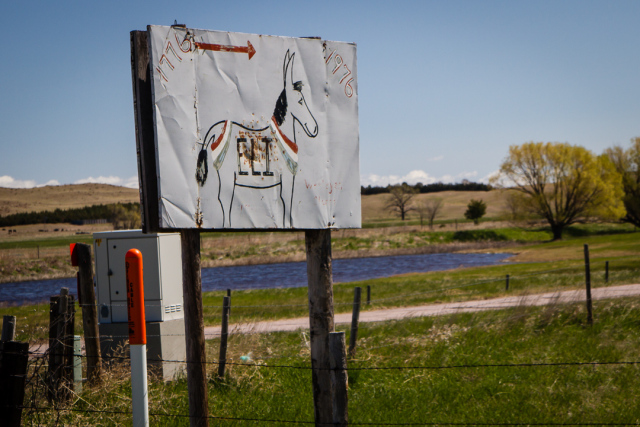
The first 14 years of Lad’s life were filled with adventure and hard work with his brothers. On the ranch, there were 17 cows to be milked twice a day, then the cream was separated and both were sold in Eli, a small bustling ranch community with a post office, general store, blacksmith shop school and Wesleyan Church that still meets every Sunday (interesting fact: the outhouse was the only bathroom facility and it had a stained glass window). There was one parking meter and a hitching post out front. The post office was established at Eli in 1909, and remained in operation until it was discontinued in 1967.

Those were also the days he learned that big boys don’t cry (when his brothers accidentally hit him in the head with a pipe). They played lots of baseball. Larry, the oldest brother, always pitched and Lad, the youngest brother, was his catcher because no one else wanted to catch Larry’s fast ball.  Their well worn catcher’s mitt was losing the padding in the center so Lad learned to adapt or hurt his hand. One day a fight broke out when Bob, the middle brother, was at bat and Larry called “strike three.” They were all rolling around in the dirt hitting each other when Mom showed up. She sent them to the creek for a willow switch. They knew that meant a paddling. But instead, she broke the switch in half, put them together, broke them, then put the three together and tried to break them but they didn’t break. And reminded them that “three strands are not quickly broken.” A lesson was learned that day that carried them through their adult lives and running a business together. A wise woman, raising wise men.

Ruth taught at a ranch school and when Lad was younger, she would take him to her school with her. He learned to drive the car by sitting on her lap and steering. When they were all school age, the boys walked to school in Eli which was just a couple of miles over hills “as a crow flies”.  Those hills became his fitness course as he ran to and from school when he was older.

There are many stories to share about Grandpa’s growing up years in the Sand Hills of Nebraska. We will save some for another day.